
Marvel Rivals is unique in the hero shooter world because of its Team-Up system. NetEase Games created it. It rewards players for teaming up specific Marvel heroes. This unlocks special abilities based on comic book lore, making team play more powerful.
This guide covers everything about these special moves. Season 3 has 21 Team-Up abilities across the game’s growing roster. Each ability is unique and only works when the right heroes are together, giving them new powers.
NetEase Games keeps the system exciting by changing Team-Ups at the start of each season. Heroes get new pairings or join existing ones. This keeps Marvel Rivals game fresh and competitive.
Knowing about Team-Up abilities is key for top-level play. It focuses on how heroes work together, not just their individual skills. This makes choosing the right team for each match very important.
Understanding Marvel Rivals Team-Up Skills Guide Fundamentals
Team-Up abilities are key in Marvel Rivals. They use Marvel lore to give heroes and villains special powers. Learning these skills is vital for winning in competitive games.
What Are Team-Up Abilities?
Team-Up abilities are unique cooperative skills that heroes use when together. They add excitement and strategy to the game. For example, Thor and Loki, or Rocket Raccoon and Groot, work together in special ways.
These abilities make the game more strategic. Players must choose heroes that work well together. This adds a new level of strategy to the game.
The Anchor Hero System Explained
Every Team-Up needs an anchor hero. This hero must be on the team for the ability to work. Without the anchor, the ability won’t happen.
- Groot is the anchor for “Planet X Pals,” needing Rocket Raccoon or Jeff the Land Shark.
- The anchor hero gets special bonuses like more health or damage.
- Season 2 added more bonuses for anchor heroes, making the game more interesting.
Passive vs Active Team-Up Mechanics
Team-Ups are divided into two types:
| Type | Activation | Example |
|---|---|---|
| Passive | Triggers automatically when eligible heroes are present or nearby | “Planet X Pals” — Groot’s companions gain damage reduction by riding his shoulders |
| Active | Requires direct player input and confirmation from both participants | “Fastball Special” — Hulk or The Thing throws Wolverine after both players confirm |
Passive abilities give ongoing buffs with no effort. Active abilities need teamwork and timing. Both are important for success.
How Team-Up Synergy Mechanics Work
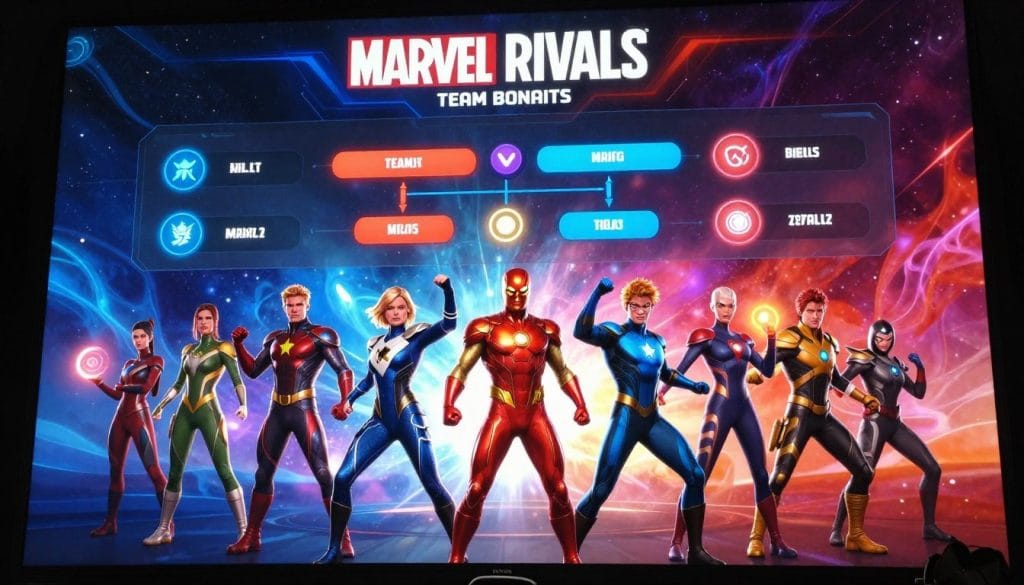
Knowing which heroes pair well together is just the start. Players must grasp how marvel rivals character partnerships work in a live match. The game has several systems to help players through this process, from the hero select screen to mid-fight activation.
Spotting Team-Up Opportunities During Hero Selection
Marvel Rivals makes spotting synergies easy before a match starts. During hero selection, icons in the centre of the screen show which heroes can bond. This helps new players and lets them try different team setups.
Activation Requirements and Proximity Conditions
Not all marvel rivals team bonuses work the same way. The way they activate depends on the Team-Up type:
- Passive Team-Ups turn on automatically when the right heroes are together and meet any proximity needs. They offer steady benefits without needing extra action.
- Active Team-Ups need players to act. The anchor hero gets a new skill, or an ally gets a boost. Players must press specific buttons, and some, like “Fastball Special” or “Stars Aligned,” need both players to agree.
Some marvel rivals character partnerships use existing ability cooldowns. For example, “Jeff-Nado” requires both Storm’s and Jeff’s ultimate abilities to be fully charged before it can be used.
Visual Indicators and In-Game Prompts
During gameplay, prompts on screen tell players when a Team-Up ability is ready. Glowing icons and button overlays show up near the ability bar. Learning to react quickly to these cues is key to being a top team. Paying close attention to these signals ensures that marvel rivals team bonuses are used wisely in key moments.
Season Three Team-Up Roster Changes
Season Three changed how marvel rivals cooperative skills work. Now, there are 21 Team-Up abilities for players to choose from. This gives them many strategic options during hero selection.
NetEase updates the game seasonally. They remove some Team-Up abilities at the start of each season. This keeps the game fresh and stops the same strategies from winning all the time.
Players should check patch notes at the start of every season to stay informed about which marvel rivals duo abilities have been added, adjusted, or removed entirely.
The Season 2.5 update made a big change. The Gamma Charge Team-Up was reworked. Iron Man was no longer part of the Hulk and Namor team. Namor’s Gamma Monstro cooldown was increased to 20 seconds, with a 10-second maximum duration.
| Change Type | Detail | Impact on Gameplay |
|---|---|---|
| Gamma Charge Rework | Iron Man removed from Hulk/Namor Team-Up | Reduces triple-hero synergy power |
| Cooldown Adjustment | Namor’s Gamma Monstro set to 20 seconds | Limits frequency of activation |
| Duration Cap | Maximum duration reduced to 10 seconds | Narrows window for aggressive plays |
| New Hero Additions | Freshly released heroes gain unique Team-Ups | Expands marvel rivals duo abilities options |
NetEase hasn’t said if old Team-Ups will come back. But, their changing approach keeps the game exciting. It rewards players who quickly adapt to new seasons.
Complete List of Marvel Rivals Combo Attacks
This guide covers all combo attacks in Marvel Rivals. Each team-up brings unique effects that can change the game. Here are some key marvel rivals team abilities players need to know.
Ragnarok Rebirth: Hela, Thor, and Loki
Hela is the key hero in this Asgardian team. She can instantly resurrect Thor or Loki after a hit. If both are alive, they get extra health. Hela also gets a +15% damage boost.
Planet X Pals: Groot, Rocket Raccoon, and Jeff
Groot is the main hero here. Rocket Raccoon and Jeff get protection while on Groot’s shoulders. Groot gains +150 max health, making him a strong shield for his friends.
Symbiote Shenanigans: Venom, Jeff, and Hela
Jeff heals an ally with symbiote tendrils, with a big burst at the end. Any extra healing turns into overhealth. Venom gets +150 max health, leading this team.
Fantastic Four: The Complete Quartet
Invisible Woman is the anchor of this team. She boosts Mister Fantastic, Human Torch, and The Thing’s damage resistance and health. She also gets a +15% healing bonus.
There are many more team-ups in the game:
- Fastball Special — Wolverine, Hulk, and The Thing
- Stark Protocol — Iron Man, Ultron, and Squirrel Girl
- Jeff-Nado — Jeff and Storm
- Guardian Revival — Adam Warlock, Mantis, and Star-Lord
- Arcane Order — Doctor Strange and Scarlet Witch
- Stars Aligned — Captain America and Winter Soldier
- Mental Projection — Emma Frost, Magneto, and Psylocke
- Primal Flame — Phoenix and Wolverine
Understanding Team Bonuses and Passive Benefits
It’s key to know the numbers behind each team-up pairing to win. The marvel rivals synergy mechanics give anchor heroes boosts. These can be damage increases, more health, or better healing.
Damage Boost Percentages for Anchor Heroes
Not all anchor heroes get the same damage boost. Hela and Magik get the highest boost at +15%. This makes them strong when paired with the right heroes. Iron Fist and Phoenix get +10%, while Iron Man, Punisher, Captain America, and Human Torch get +5%.
Health and Healing Bonuses Breakdown
Passive health bonuses make heroes more durable. Groot and Venom gain +150 max health, making them tough. Hulk, Doctor Strange, Captain America, and Emma Frost get +100, and Punisher gets +25.
On the healing side, Cloak & Dagger, Adam Warlock, Luna Snow, and Invisible Woman get +15% healing. Rocket Raccoon gets +5%.
| Bonus Type | Hero | Value |
|---|---|---|
| Damage | Hela, Magik | +15% |
| Damage | Iron Fist, Phoenix | +10% |
| Damage | Iron Man, Punisher, Captain America, Human Torch | +5% |
| Max Health | Groot, Venom | +150 |
| Max Health | Hulk, Doctor Strange, Captain America, Emma Frost | +100 |
| Healing | Cloak & Dagger, Adam Warlock, Luna Snow, Invisible Woman | +15% |
| Healing | Rocket Raccoon | +5% |
Duration and Cooldown Management
Active marvel rivals combo attacks have different cooldowns. This affects when you can use them. Stark Protocol’s Nano-Ray resets every 30 seconds. Gamma Monstro needs 20 seconds but lasts up to 10.
Guardian Revival has a long 120-second cooldown. Using it too soon can cost you a fight. Abilities like Jeff-Nado use ultimate charge, adding to the planning needed.
Strategic Character Partnerships for Competitive Play
Winning in ranked modes requires smart drafting. The best marvel rivals character partnerships form during the hero selection screen. Teams that coordinate their picks can unlock devastating synergies that swing entire matches.
The anchor hero is a high-priority pick — or a strategic ban target. Even when a Team-Up ability is not actively in use, the anchor’s personal passive bonus makes them inherently more valuable. Securing or denying anchor heroes can dictate the pace of an entire round.
Choosing between passive and active Team-Ups reflects a team’s coordination level and appetite for risk:
- Passive Team-Ups offer reliable, consistent benefits with minimal execution demands. They suit solo queue play or groups with limited voice communication.
- Active Team-Ups carry higher impact but require precise timing and strong callouts. Well-drilled squads favour these for game-changing plays.
A cooldown economy emerges around marvel rivals team bonuses at higher ranks. Forcing an opponent to burn a powerful Team-Up defensively — or at a poor moment — removes that threat for the full cooldown window. This grants a tactical edge heading into the next objective fight.
| Factor | Passive Team-Ups | Active Team-Ups |
|---|---|---|
| Execution Difficulty | Low | High |
| Communication Need | Minimal | Essential |
| Impact Ceiling | Steady, moderate | Explosive, game-changing |
| Risk of Failure | Very low | Significant |
| Best Environment | Solo queue | Pre-made squads |
Understanding these trade-offs lets players build marvel rivals character partnerships that match their playstyle. The marvel rivals team bonuses they unlock can be the deciding factor between a narrow loss and a clean victory.
Mastering Marvel Rivals Cooperative Skills
Knowing team-up pairings is one thing. But using them well under pressure is another. To master marvel rivals cooperative skills, you need sharp communication, precise timing, and knowledge of the enemy’s moves.
Communication Requirements for Active Abilities
Active team-ups like Fastball Special and Stars Aligned need confirmation from both players. Without voice chat or quick pings, these abilities can be wasted. Teams that confirm their readiness have an advantage in ranked play.
Timing Your Team-Up Activations
Coordinating attacks with available marvel rivals duo abilities is key. Engage when a synergy is ready. If it’s on cooldown, defend until it’s available again.
Countering Enemy Team Synergies
Keep track of the enemy’s moves to find openings. After Hela uses Ragnarok Rebirth to revive an ally, she’s vulnerable. Each enemy pairing has a counter:
| Enemy Team-Up | Effective Counter | Why It Works |
|---|---|---|
| Stark Protocol | Groot, Doctor Strange, or Emma Frost shields | Blocks the beam damage entirely |
| Gamma Charge (Gamma Monstro) | Thor’s targeted strikes | Destroys the Monstro directly |
| Symbiote Shenanigans | Groot’s Ironwood Wall or Invisible Woman’s displacement | Pushes or pulls disrupt the combo |
| Operation: Microchip | Mobile heroes like Spider-Man | High mobility avoids the lock-on zone |
Baiting Out Powerful Team-Up Cooldowns
Smart teams use enemies’ powerful abilities at the wrong time. A fake push can make enemies use their defensive team-ups, leaving them vulnerable. This strategy shapes the game’s pace and separates skilled teams from casual ones.
Top-Tier Marvel Rivals Duo Abilities Analysis
Some marvel rivals team abilities are way ahead in power and winning chances. This guide focuses on four key duo synergies that every player should aim for, in depth analysis of Marvel’s best tier lists is available on it’s designated page.
Stark Protocol: Iron Man and Ultron Synergy
Iron Man and Ultron together create a powerful Nano-Ray beam. This beam can hit all characters on the map. It damages foes and heals friends, building up ultimate charge.
Iron Man gets a 5% damage boost. Without Ultron, Ultron’s power drops, making this duo vital for winning.
Gamma Charge: Hulk and Namor Partnership
Namor can now call out a Gamma Monstro after Season 2.5. This creature fires gamma rays at enemies. The damage grows as the beam stays on target.
Hulk gets +150 health from this bond. Namor should place the Gamma Monstro in hard spots to keep it alive longer.
Operation Microchip: Punisher and Black Widow
This duo has a unique trade-off. Black Widow’s shots turn into piercing beams. She can’t get headshots while this is active. Punisher gets +25 health and a 5% damage boost.
This combo shines in Domination mode and tight spots where beams hit multiple targets.
Jeff-Nado: Storm and Jeff Ultimate Combination
This combo is the game’s most spectacular. Jeff gets pulled into Storm’s Omega Hurricane, pulling in opponents. Both ultimates need to be charged before it works.
Timing is everything for this combo. But the result is a team wipe.
When two ultimates merge into one, the battlefield changes in seconds.
| Duo Synergy | Anchor Hero | Key Benefit | Best Scenario |
|---|---|---|---|
| Stark Protocol | Iron Man | Map-wide piercing beam | Chokepoints and objective pushes |
| Gamma Charge | Hulk | +150 max health, scaling damage | Sustained engagements |
| Operation Microchip | Punisher | Piercing pulse beams | Domination mode |
| Jeff-Nado | Storm | Combined ultimate devastation | Team fight finishers |
Conclusion
Team-Up abilities are a key feature in Marvel Rivals. They bring comic book lore into 6v6 hero shooter gameplay. NetEase Games rewards players for teaming up, not just playing solo.
With 21 Team-Up abilities in Season 3, it’s vital to understand how they work. This knowledge is key for climbing the competitive ranks.
Knowing how to use anchor heroes and manage cooldowns is important. It’s what sets winning teams apart. Marvel rivals character partnerships need teamwork and timing.
Players must communicate well and use abilities at the right moment. This is how you make big plays in the game.
Whether it’s Storm and Jeff or the full Fantastic Four, these partnerships bring comic book moments to life. NetEase Games keeps improving these mechanics with each update. Mastering them is essential for winning and shaping effective teams.